§ How-To
Brad Nail Size Guide for Trim, Casing, and Cabinets
Break down when to choose 18 gauge versus 16 gauge nails and how length affects holding power and surface finish. Include practical examples for baseboards, crown, light assembly, and furniture detailing.
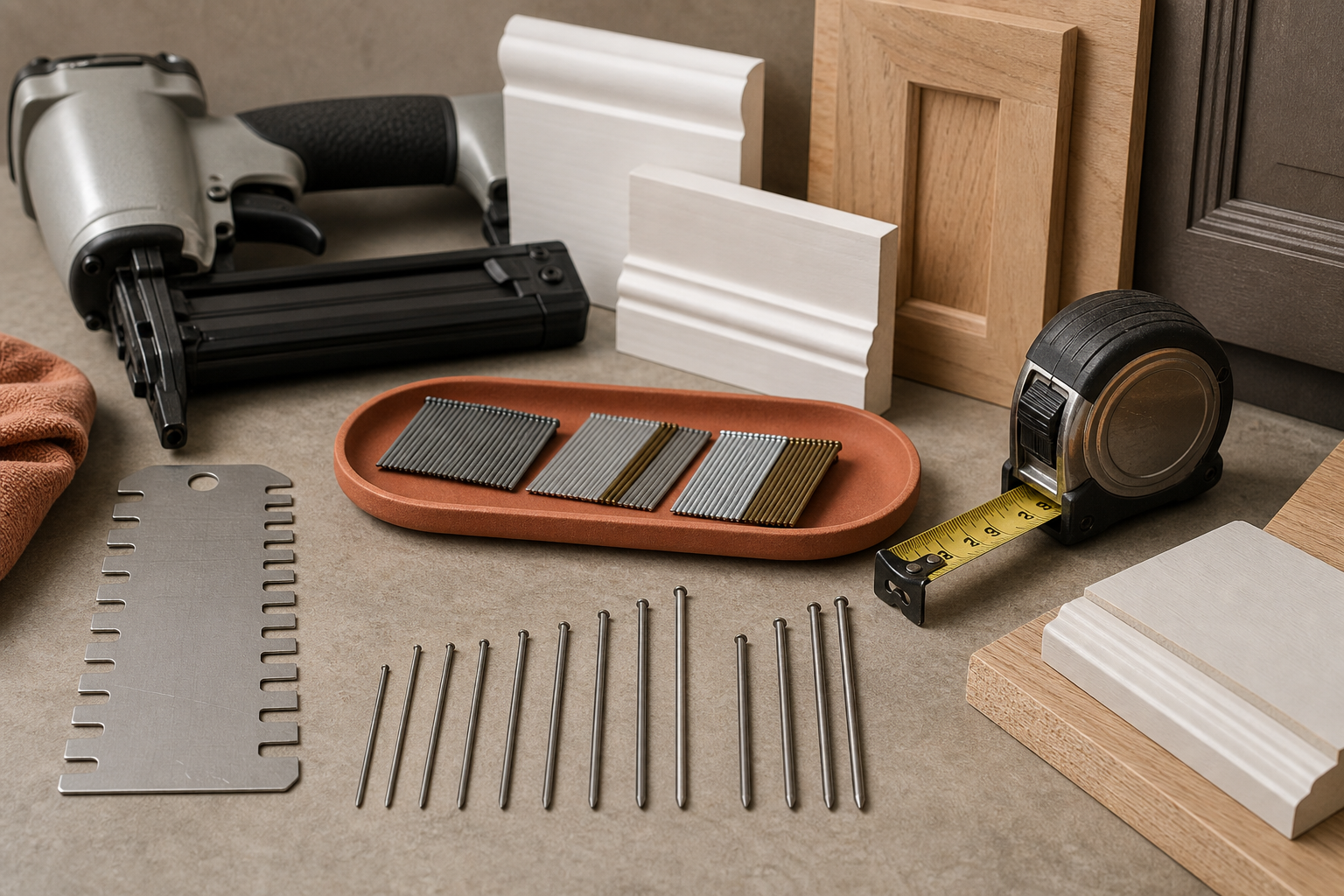
Brad nails are small, clean-fastening finish nails designed for trim work where appearance matters as much as holding power. The right nail choice comes down to two things: gauge and length. If you use too light a nail, parts can loosen or split away from the wall over time. If you go too heavy or too long, you risk visible holes, split trim, or blow-through on delicate material. For trim, casing, and cabinet work, understanding when to use 18 gauge versus 16 gauge nails makes the job faster, cleaner, and more dependable.
Understanding 18 Gauge vs. 16 Gauge Nails
The first choice is nail thickness. In finish carpentry, 18 gauge brad nails and 16 gauge finish nails serve different purposes.
An 18 gauge brad nail is thinner, leaves a smaller hole, and is best for lighter trim and fine-detail work. It’s a go-to choice when surface appearance is critical or when the material is narrow and more likely to split. Brad nails hold well in lightweight applications, but they do not provide the same gripping strength as thicker finish nails.
A 16 gauge finish nail is thicker and stronger. It leaves a slightly larger hole that usually needs filling, but it offers noticeably better holding power. This makes it the better choice for heavier trim, longer runs, or materials under more stress.
A simple way to think about it:
- Use 18 gauge for delicate trim, cabinet detailing, light assembly, and smaller moldings
- Use 16 gauge for baseboards, door casing, crown molding support, and heavier finish pieces
If you are fastening a trim piece that also needs to stay tight against uneven framing or resist seasonal movement, 16 gauge is usually the safer choice. If you are pinning a small decorative piece in place with minimal patching afterward, 18 gauge is often ideal.
How Nail Length Affects Holding Power
Length matters just as much as gauge. A common rule is to drive enough nail so that it penetrates at least 3/4 inch to 1 inch into the backing material, when possible. That gives the fastener enough bite without excessive blowout risk.
Typical brad and finish nail lengths range from 5/8 inch to 2-1/2 inches, depending on tool type. For most trim and cabinet tasks, these are practical guidelines:
- 3/4 inch to 1 inch: thin trim, light assembly, narrow decorative pieces, applied moldings
- 1-1/4 inch to 1-1/2 inch: cabinet trim, small casing, furniture parts, light face frames
- 2 inch to 2-1/2 inch: baseboards, door casing, crown support, thicker trim into studs or solid backing
Longer nails increase holding power, but only if the substrate can accept them cleanly. In thin material, going too long can cause the nail to exit the side, especially in hardwood trim or at angled shots. In soft trim over drywall, a nail that only grabs drywall and misses framing will not hold well regardless of length.
For clean results:
- Match nail length to the combined thickness of the trim and substrate
- Increase length for heavier trim or weak backing
- Reduce length for thin stock, narrow moldings, and hardwood details prone to splitting
Practical Nail Choices for Common Jobs
Here is where most users make the decision at the bench or on the jobsite.
Baseboards
Baseboard usually benefits from 16 gauge nails, typically 2 inch to 2-1/2 inch long. Base is often thicker than casing and may need to pull tight against slightly uneven walls. The extra holding strength of 16 gauge helps keep the profile seated. For very small or flexible base shoe, 18 gauge 1-1/4 inch to 1-1/2 inch nails may be more appropriate.
Door and window casing
Standard casing can be installed with either gauge, depending on size and wall conditions. For most full-size casing, 16 gauge at 2 inches is a dependable choice. For lighter, narrow casing or prefinished trim where minimizing hole size matters, 18 gauge at 1-1/2 inch to 2 inches can work well if the backing is solid.
Crown molding
Crown often needs more than just a small tack. For support and long-term hold, 16 gauge is usually preferred, especially in larger profiles. Lengths around 2 inch to 2-1/2 inch are common when fastening into wood backing, studs, or ceiling framing. Small decorative crown or cabinet crown may be secured with 18 gauge if the material is lightweight.
Light assembly
For light shop assembly, small trim jigs, or tacking parts while glue cures, 18 gauge nails are ideal. Lengths from 3/4 inch to 1-1/4 inch are common. They hold parts without causing major surface damage and are especially useful on painted or delicate pieces.
Furniture detailing and cabinet trim
Applied moldings, cabinet skins, small face trim, and decorative furniture details usually call for 18 gauge brads. Use 1 inch to 1-1/2 inch lengths for most applications. They leave a much smaller hole and reduce the chance of splitting narrow stock. If you are fastening thicker face frames or heavier cabinet parts structurally, step up to 16 gauge where appropriate.
Tips for Better Results and Fewer Callbacks
Choosing the right nail is only part of the job. Technique matters.
- Test on scrap first, especially with hardwood, MDF, or prefinished trim
- Watch grain direction on narrow moldings to reduce side blowout
- Angle opposing nails slightly on trim for better grip when framing is limited
- Use adhesive where needed, particularly on large trim, cabinet parts, or uneven surfaces
- Set air pressure correctly so nails sink just below the surface without overdriving
- Fill only what you need: 18 gauge holes are easier to hide, while 16 gauge holes may need more finish work
For many homeowners and DIY users, the cleanest approach is to keep both nail types available: 18 gauge for detail work and 16 gauge for stronger trim installation. That combination covers most interior finishing and cabinet touch-up jobs with less guesswork.
FAQ
Can I use 18 gauge brad nails for baseboards?
Yes, for small base shoe, quarter round, or very light trim. For full-size baseboards, 16 gauge nails usually provide better holding strength.
What size nail is best for cabinet trim?
For applied cabinet moldings and decorative trim, 18 gauge nails in the 1 inch to 1-1/2 inch range are commonly the best fit. For thicker structural cabinet parts, 16 gauge may be the better choice.
Does a longer nail always hold better?
Not always. A longer nail only helps if it penetrates solid backing without blowing out the material. Too much length in thin trim can cause splits, poor alignment, or visible damage.
§ Catalog
Shop the catalog